
Knowledge, Attitude and Practice of Reproductive Health Medicines Use Among Women in Health Facilities in Benue State, Nigeria
DOI:
https://doi.org/10.51412/psnnjp.2026.018Keywords:
attitude and reproductive, practice, knowledge, reproductive health medicinesAbstract
Background: The United Nations Millennium Development Project emphasizes that universal access to Sexual and Reproductive Health (SRH) services, information, and education is essential for reducing child mortality and improving maternal health. Despite concerted efforts to improve Reproductive Health Medicines (RHMs) utilization among women, the prevalence rate of usage has remained abysmally low.
Objective: This study aims to evaluate the knowledge, attitude, and practice (KAP) on the use of RHMs among women attending different levels of healthcare institutions in Benue State, Nigeria
Method: This was a descriptive cross-sectional study of women of reproductive age who assessed RHMs at selected health care facilities in Benue State. Information on their age, Parity, and KAP regarding RHMs use was obtained using a structured questionnaire. Sociodemographic characteristics were summarized as frequency counts and percentages. One-way ANOVA was performed to determine significant differences among groups of women who visited the health facilities at P<0.05.
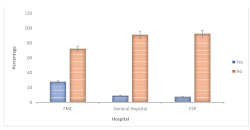
Results: The predominant age of women across the health facilities was 21–30 years. Women attending the three health facilities demonstrated moderate knowledge of reproductive health medicines (RHMs), with health care professionals serving as the major source of information. Knowledge of diaphragms differed significantly among respondents, with women attending the General Hospital recording the highest mean knowledge score (2.67±1.24), followed by FSP (2.01±0.65). The attitude towards the use of these medicines among women showed that respondents reported traditional barriers as a major concern. There was higher condom use among respondents from the General Hospital (4.14 ± 0.68). Overall, contraceptive prevalence (tertiary, 27.9%, secondary (9.1%) and primary (7.5%) health facilities), and substance use remained low across all facilities.
Conclusion: Significant differences in knowledge, attitudes, and utilization of contraceptive methods were observed across the three health facilities, particularly regarding diaphragm knowledge, traditional barriers, and contraceptive preferences. Despite the availability of reproductive health medicines, overall contraceptive utilization remained low, highlighting the need for strengthened reproductive health education and targeted interventions to address cultural barriers and improve uptake of family planning services.
References
1. Atoyebi AO, Olaoye SO, Olaoye SO, Okunola MA,Palamuleni ME and Adewole AS (2025) Trends and pattern of contraceptive use among women attending a family planning clinic at a tertiary health facility in Ibadan, Nigeria. BMC Public Health, 25(1):2134. doi: 10.1186/s12889-025-23284-0
2. National Population Commission (NPC) [Nigeria] and ICF International (2019) NigeriaDemographic and Health Survey 2018.
Key Indicators Report. NPC and ICF, Abuja and Rockville, Maryland, USA: NPC and ICF. Available at: DHS Program NDHS 2018 Report
3. Federal Ministry of Health and Social Welfare (FMoHSW), National Population Commission (NPC) [Nigeria] and ICF (2025) Nigeria Demographic and Health Survey 2024: Key Indicators Report. Abuja, Nigeria, and Rockville, Maryland, USA:FMoHSW, NPC and ICF[last accessed 2026, May 17]
4. Orjingene O, Teryila O (2022) Utilization of family planning services in Africa's most populous nation, are we at a tipping point. Journal of Gynecology & Reproductive Medicine, 6 (3):139-45. https://dx.doi.org/10.33140/JGRM
5 Fayehun F (2017) Contraceptive use in Nigeria is deficient. A lack of knowledge may be why. The conversation. University of Ibadan. https://doi.org/10.64628/AAJ.csnxtasv5
6. Starbid E, Norton M, Marcus R (2016) Investing in family planning is key to achieving sustainable development goals. Glob Health: Science and Practice, 4(2): 191 - 210. https://doi.org/10.9745/GHSP-D-15-00374
7. United Nations. (2025). The Sustainable Development Goals Report 2025. United Nations Department of Economic and Social Affairs, Statistics Division. Published July 14, 2025. Available at: https://unstats.un.org/sdgs/report/2025/TheSustainable-Development-Goals-Report2025.pdf.
8. Koroma AH, Fofanah EY, Osborne A, Williams SMT, Bangura C, Musa JA, Johnny J, Saidu JB, Bakarr IA (2022) Assessment of knowledge, attitude and practice on family planning among women of reproductive age at hospitals and clinic centers in the rural Western Sierra Leone. African Journal of Reproductive Health, (6):15-21. doi: 10.29063/ajrh2022/v26i6.2
9. Azees AS, Ehiem EC, Isa A, Awosan KJ, Suleiman AM (2022) Prevalence, pattern and determinant of contraceptive use among pregnant women attending ANC in a secondary health facility in Kebbi State: A cross-sectional study. Pan African Medical Journal, 41: 179. doi: 10.11604/pamj.2022.41.179.30352
10. National Demographic and Health Survey (NDHS). Demographic and Health Survey 2013. National Population Commission and ICF International. Abuja – Nigeria: National Population Commission and ICF International; 2014. available from:
http://dhsprogram.com/publication/publicationfr293dhs-finalreports. Cfm#sthash.v67EQimm.dpref (Accessed 2022, July 28)
11. WHO. 22nd Expert Committee on the Selection and Use of Essential Medicines - Application for Mifepristone-Misoprostol. 2018;12. United Nations, Department of Economic and Social Affairs, Population Division.
12. United Nations Department of Economic and Social Affairs (UN DESA) (2024). UN DESA Policy Brief No. 172: The New Landscape of Fertility and Family Planning 30 Years After Cairo and Beijing. Available at: UN DESA Policy Brief No. 172 (Accessed:17 May 2026)
13. Ukoji VU, Anele PO, Imo CK (2022) Assessing the relationship between knowledge and the actual use of contraceptives among childbearing women in South-South Nigeria: evidence from the 2018 Nigeria demographic and health survey. BMC Publi c Health, 22(1):2225. doi: 10.1186/s12889-022-14728-y.
14. Alyafei A, and Easton-Carr R (2024) The Health Belief Model of Behavior Change. In: StatPearls [Internet]. Treasure Island (FL): StatPearls Publishing. Available at: https://www.ncbi.nlm.nih.gov/books/NBK606120/ Accessed 25th March, 2026.
15. Boskey E (2025) How the health belief model influences your behaviour. Available from: https://www.verywellmind.com/health-beliefmodel-3132721. Accessed 15th October,2025.
16. Adetunmise Oluseyi Olajide; Modupe Sidikat Isiaka; Ganiyat O. Adeniran, et al(2024) The utilization of family planning among women of reproductive age attending a teaching hospital, Oyo State, Nigeria. Rwanda Medical Journal, 81 (3):28-37 https://dx.doi.org/10.4314/rmj.v81i3.3
17. Jimoh OS, Vaughan TA, Adeniyi MA, Ahmed AK, Sule –Odu IO, Badmaasi-AbdulRahem TM et al (2024) Patterns and predictors of contraceptive uptake among women attending family planning in a tertiary health facility in south-west Nigeria: a 10 – year review. African Journal of Research in Medical and Health Sciences, 2(1):12-19. https://doi.org/10.60787/ajrmhs-v2i1-22
18. Alkalash S H, Alessi S M, Alrizqi AA, et al. (2023) Knowledge on, Attitude Toward, and Practice of Contraceptive Methods Among Females of Reproductive Age in Al-Qunfudah Governorate, Saudi Arabia. Cureus, 15(3): e36606. DOI: 10.7759/cureus.36606
19. Akpoti OO, Kareem AJ, Kareem AO, Ogunromo AY, Owoeye-Lawal OT, Ahmed LA., Akinyugha AO, Bewaji TO, Babalola EO, Orji EJ, Atimoh, CO, & Ibekwe OC (2023) Demand for modern contraceptives and use among women of reproductive age in north central Nigeria. International Journal of Community Medicine and Public Health, 10(3), 958 – 967. https://doi.org/10.18203/2394-6040.ijcmph20230607
20. Kavanaguh ML and Zolna MR (2023) Where Do Reproductive-Aged Women Want to Get Contraception? Journal of Women's Health, 32(6). https://doi.org/10.1089/jwh.2022.0406
21. Mwesigwa G (2024) Assessment of the Knowledge, Attitudes and Practices of Emergency Contraception among Women of Reproductive Age Visiting Kampala International University Teaching Hospital. Research Invention Journal of Current Issues in Arts and Management, 3(3):20-28
22. Abejo JRA, Gulle JS Jr., Montajes RS Jr. (2024) Knowledge, Attitude, and Practices of Contraceptives Used among Indigenous Women of Reproductive Age in Barangay Hawilian, Esperanza, Agusan Del Sur. American Journal of Agricultural Science, Engineering, and Technology, 8(1)1 - 17. https://doi.org/10.54536/ajaset.v8i1.2303
23. Akinloye O, Adediji I, Samuel TA, Popoola O, Iranloye BO, et al. (2022) Contraceptive Use among Women Assessing Family Planning Services in Different Levels of Health Care Facilities: A Decades Retrospective Review. Journal of Community Medicine and Public Health Reports, 3 (05): https://doi.org/10.38207/JCMPHR/2022/JUL03050366
24. Kasso T and Alegbeleye, JO (2023) Knowledge, Attitude and Practice of Contraceptive Use among Women of Reproductive Age in Port Harcourt, Nigeria. Advances in Reproductive Sciences. 11: 93 - 105. https://doi.org/10.4236/arsci.2023.114009
25. National Population Commission (NPC) and ICF (2024) Nigeria Demographic and Health Survey2023–2024. Abuja, Nigeria and Rockville, Maryland, USA: NPC and ICF.
26. Tewabe T, Ayalew T, Abdanur A, Jenbere D, Ayehu M, Talema G, Asmare E (2020) Contraceptive use and associated factors among sexually active reproductive age HIV positive women attending ART clinic at Felege Hiwot Referral Hospital, Northwest Ethiopia: A crosssectional study. Heliyon, 6(12). https://doi.org/10.1016/j.heliyon.2020.e05653
Downloads
Published
How to Cite
Issue
Section
License

This work is licensed under a Creative Commons Attribution-NonCommercial 4.0 International License.